Showing posts with label ERP. Show all posts

Thursday, September 15, 2011

ERP:Making It Happen


ERP:Making It Happen
The Implementers' Guide to Success with Enterprise Resource Planning
Wiley | 2001-07-27 | ISBN: 0471392014
384 pages | PDF | 1,5 MB

 Follow the "Proven Path" to successful implementation of enterprise resource planning.  Effective forecasting, planning, and scheduling is fundamental to productivity-and ERP is a  fundamental way to achieve it. Properly implementing ERP will give you a competitive  advantage and help you run your business more effectively, efficiently, and responsively.

This guide is structured to support all the people involved in ERP implementation-from the  CEO and others in the executive suite to the people doing the detailed implementation work  in sales, marketing, manufacturing, purchasing, logistics, finance, and elsewhere.


Enterprise Resource Planning for Global Economies


Enterprise Resource Planning for Global Economies 
Managerial Issues and Challenges
Carlos Ferran, Ricardo Salim
Information Science Reference | 2008-04-04 | ISBN: 1599045311
420 pages | PDF | 3,7 MB

 Local functional systems that create inefficient islands of information are being replaced  by expensive enterprise-wide applications that unify the functional areas; however, while  we have not yet been able to completely and seamlessly integrate across functions, we find  that the new islands of information are no longer functional but political, cultural,  linguistic, and geographical. The global village is a reality and enterprise resource  planning (ERP) implementations face new issues and challenges.

 Enterprise Resource Planning for Global Economies: Managerial Issues and Challenges  provides authoritative research on the theoretical frameworks and pragmatic discussions on  global implementations of information systems, particularly ERP systems. This book offers  professionals, managers, and researchers who want to improve their understanding of the  issues and challenges that arise when information systems cross national boundaries with an  authoritative, essential research resource.


Management Accounting in Enterprise Resource Planning Systems


Management Accounting in Enterprise Resource Planning Systems
Severin Grabski, Stewart Leech, Alan Sangster
Publisher: CIMА Рublishing | 2009-06-26 | ISBN: 1856176797
PDF | 180 pages | 2.35 MB

Current evidence points to management accountants using traditional software (such as spreadsheets) for budgeting, ABC, balanced scorecards and other performance management techniques independent of, rather than integrated with Enterprise Resource Planning (ERP) Systems.
While there has been some limited research on the effects of ERP systems on management accountants, this report provides a comprehensive analysis of the consequences of implementation of ERP systems for management accountants.
 
This report provides a theoretical basis for studying the impact of Enterprise Resource Planning (ERP) systems on management accounting and provides critical insights into the opportunities provided by ERP systems for the most efficient use of management accounting techniques.
The seven UK case studies of ERP implementations reveal the correlation between the success of the system implementation and the development of the role of management accountants in business partners thereby identifying the changes and skills required of management accountants.
The book provides guidance to management accountants on the changes they need to make in order to achieve the most from an ERP system implementation.


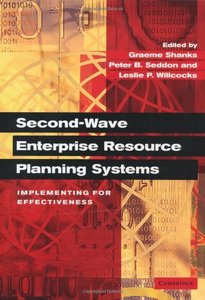
Second-Wave Enterprise Resource Planning Systems


Second-Wave Enterprise Resource Planning Systems
 Implementing for Effectiveness 
By Graeme Shanks, Peter B. Seddon, Leslie P. Willcocks 
Publisher: C U P 2003 | ISBN: 0521819024 
 PDF | 2 MB  | 468 Pages

The focus of this book is on the most important class of enterprise system, namely Enterprise Resource Planning (ERP) systems. Organisations typically take the decision to employ ERP systems in an attempt to streamline existing processes. Once these systems are in place, however, their success depends on the effectiveness of the implementation, and on the additional benefits that can be obtained by further leveraging the technology. In this book, the editors have assembled some of the world's best research on ERP systems, with a view to providing a foundation for second wave improvements to enterprise systems. Written primarily for managers and consultants, this book is also an ideal reference for business schools and researchers.